Guide

How Shipping Containers Are Made: The SCS Global Manufacturing Process

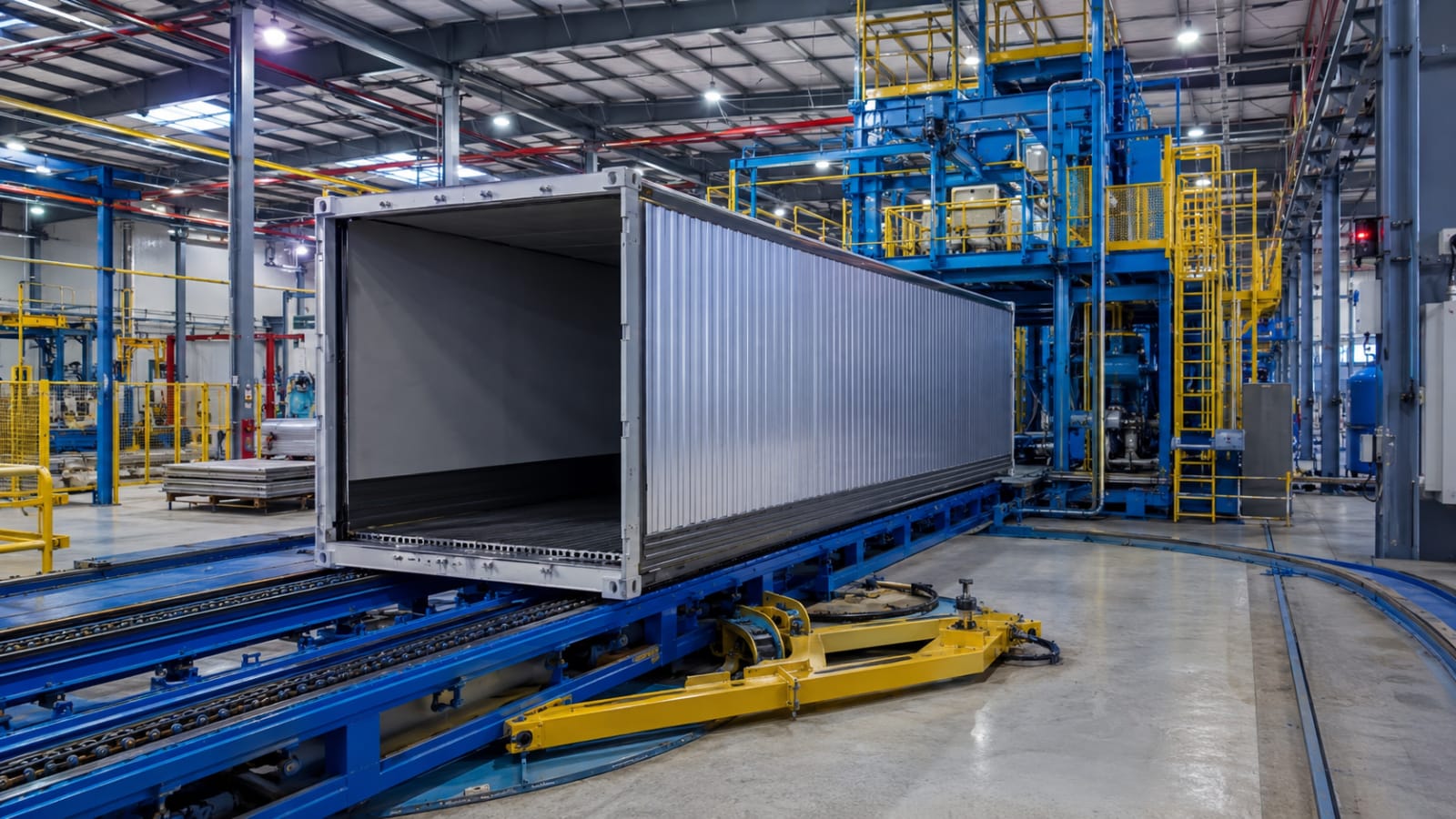
The shipping container manufacturing process turns coils of weathering steel into a sealed, CSC-platable box through about 14 controlled stages, from steel receiving to the Safety Approval Plate. SCS builds these units new at our own factory, so what follows is a first-hand account, not a reseller's summary.

Summary

A shipping container is built new from corrugated weathering (Corten) steel through about 14 controlled stages, from steel-coil receiving to the CSC Safety Approval Plate. Each stage feeds the next: cut and form the steel, weld the frame, box the structure, blast and paint it, fit the floor and doors, then test and certify. This guide sits alongside our manufacturing & quality assurance pages at SCS Global, covering the product specifications and compliance documentation that support the same procurement audience.

01

Overview

How shipping containers are made: an overview

That sequence is the same whether the unit is a standard 20ft box or an engineered custom build, which is how a single factory keeps quality consistent across very different products. The early stages are about material and geometry, the middle stages about welding and coating, and the final stages about sealing, marking and proving the box. This page explains how shipping containers are made in that order, then links to the deeper materials, quality and certification detail.

The 14 stages at a glance

  1. Raw-material handling and incoming quality control
  2. De-coiling, straightening and CNC cutting
  3. Shop priming
  4. Roll forming and corrugation pressing
  5. Floor frame and cross-member fabrication
  6. Corner castings and corner posts
  7. Sub-assembly welding
  8. Boxing, cubing and final welding
  9. Shot blasting and surface preparation
  10. Multi-coat painting
  11. Marine plywood flooring
  12. Door hardware and seals
  13. Marking and identification
  14. Water-tightness test and final quality control
02

Materials

What shipping containers are made of: materials

What are shipping containers made of comes down to four things: a corrugated weathering-steel shell, a welded steel frame, eight ISO 1161 corner castings, and a marine-grade plywood floor, all sealed with a multi-coat marine paint system. Weathering steel is the headline material because it forms a protective patina and resists corrosion two to eight times better than ordinary carbon steel.

The shell panels are corrugated weathering steel, the frame is heavier S355-class steel that carries stacking and transport loads, and the floor is 28 mm marine-grade plywood screwed to the cross-members. The full grade, gauge and coating detail sits on the steel and materials we build with. Standard tare weights give a sense of how much steel goes into each size: roughly 4,914 lb (2,229 kg) for a 20ft, 8,159 lb (3,701 kg) for a 40ft and 8,747 lb (3,968 kg) for a 40ft high-cube. SCS builds these from first-life steel rather than repurposed boxes, so the material starts at full rated thickness. The same line produces the containers we make across nine product categories.

03

Steel prep

Steel receiving, cutting and forming

Manufacturing starts with incoming quality control on the weathering-steel coil: grade, thickness, chemical composition and tensile strength are checked before any steel reaches the line. Material that fails intake never becomes a container.

Once accepted, the coil is de-coiled, straightened and cut to size on CNC plasma or laser equipment, with automated measurement and calibration holding the cut dimensions. A shop primer goes on early to protect the bare steel before fabrication. The panels then pass through a corrugation press, which stamps the wave profile that gives a thin sheet its bending stiffness. Each unit is fabricated to the external envelope set by ISO 668, the series-1 freight-container dimension standard, so a 20ft box measures 6,058 mm long and a high-cube stands 2,896 mm tall. Getting the cut and the corrugation right at this stage is what keeps panel fit-up tight through welding, which is why we control burr and misalignment with back-gauge and roll-angle settings rather than grinding problems out later.

04

Frame

Floor frame and cross-member welding

The base of the container is a welded steel grid: two longitudinal bottom side rails with a ladder of cross-members welded between them. This frame carries the floor and transfers forklift and cargo loads into the corner structure.

Cross-members are spaced and welded to hold the marine plywood floor flat under a concentrated wheel load, and the joints are ground smooth so the floor panels seat without rocking. The frame is the first major sub-assembly to take shape, and its accuracy sets up everything that follows, because the corner castings and posts weld to this base. Build the grid square and the box stays square. Build it out of tolerance and every later stage fights it. The structural performance of the finished floor is later proven against the load tests in ISO 1496-1, the specification that defines how much a container floor must carry without permanent deflection.

05

Castings

Corner castings, corner posts and sub-assembly welding

SCS casts its own ISO 1161 container corner castings and offshore-grade DNV castings in-house, the structural parts most container makers buy in. Eight castings and the vertical corner posts weld into the frame to form the certified lifting and stacking points of the box.

Each container corner casting is made to ISO 1161 geometry, the standard that governs the corner and intermediate fittings every crane, spreader and twistlock engages. Because we run our own foundry, the castings, padeyes, lifting lugs and lashing gear that carry every lift are made and traced under our own control, and SCS-cast components are used by other manufacturers including CIMC. Sidewalls, roof, doors and base are then welded into sub-assemblies using MIG/TIG and robotic welding, with weld parameters such as gas flow, wire-feed speed and voltage held to set values and every weld visually inspected before assembly continues. This is the single stage where vertical integration shows: the part that fails first on a cheap box, the corner casting, is one we make ourselves. You can see the foundry in our production line and factory capability.

The part that fails first on a cheap box, the corner casting, is one we make ourselves.

06

Coating

Boxing, shot-blasting and the shipping container paint system

Boxing is where the sub-assemblies come together: walls, base and doors are aligned on fixtures, fully structurally welded, and the roof is installed last. The completed shell is then shot-blasted and painted as one structure.

The whole box is shot-blasted to Sa 2.5 under ISO 8501, removing mill scale, rust and oil so the coating bonds to clean, profiled steel. A multi-coat marine system follows: primer, intermediate coat and topcoat, using marine coatings and a two-component epoxy, with the under-structure coated as carefully as the visible panels. Dry-film thickness is verified with calibrated gauges before the unit moves on, and the corrosivity target follows ISO 12944, where marine and offshore service sits in the C5-M and CX categories. Surface preparation, not the paint itself, is what decides coating life, so the blast standard is treated as the controlling step. Skip or rush it and even an expensive topcoat lifts within a season.

07

Flooring

Marine-grade plywood flooring

The floor is 28 mm marine-grade plywood, usually apitong or keruing hardwood, treated against moisture and insects and screwed down to the steel cross-members. It carries forklift wheel loads and palletised cargo without flexing.

Marine-grade plywood is specified over softwood because dense tropical-hardwood veneers resist crushing and the adhesive survives humidity cycling. The panels fix with self-tapping screws into the cross-member grid, so a damaged floor can be lifted and replaced without cutting the shell. A steel chequer-plate floor is fitted where a unit will see tracked plant or aggressive spillage. Whatever floor goes in, it is proven by the forklift and concentrated-load tests in ISO 1496-1, which set the deflection limits a loaded container floor must hold. The floor is one of the last structural elements fitted, after painting, so the coating reaches the cross-members underneath it.

08

Doors

Doors, locking gear and the water-tightness test

The doors are fitted with rubber gaskets and multi-point locking gear, then tested for square operation before the box is sealed and water-tested. A high-pressure water-jet shower test confirms the unit is watertight.

Door hardware matters more than it looks: the vertical locking bars and cams have to compress the gasket evenly so the seal holds under racking and on uneven ground. Once the doors swing true and latch, the container goes through a water-tightness shower test, where high-pressure jets simulate driving rain across the roof, seams and door seals. Any light visible from inside, or any ingress, sends the unit back for rework. Weatherproofing is part of the type-test battery in ISO 1496-1, and on a sealed box it is the test that protects whatever the buyer ships inside. A leak found here is cheap. A leak found in the field ruins a cargo.

09

Marking

Marking, identification and the CSC Safety Approval Plate

Every finished container is marked with an ISO 6346 identification code, an 11-character BIC code made up of an owner prefix, an equipment category letter, a six-digit serial number and a check digit. The CSC Safety Approval Plate is fixed at this stage, after first examination.

The marking makes the box traceable across ports and fleets, and the size and type codes tell handlers exactly what they are lifting. The CSC Safety Approval Plate, required by the International Convention for Safe Containers, is stamped and fixed once an authorised classification society completes the first examination at the factory. Because SCS builds new units, this happens on the line rather than after delivery. The full factory-stage process, from type-test to plate stamping and ACEP enrolment, is set out in CSC certification at the factory, and the wider regulatory lifecycle in our container certification explained guide.

10

Quality control

Quality control at every stage

Quality control runs the length of the line, not just at the end. Incoming steel, every weld, dimensional tolerances, coating thickness and water-tightness are each checked as the unit is built, and the records are kept as photographic evidence.

SCS provides full photographic QC reports stage by stage, plus Factory Acceptance Testing on engineered units, so a buyer can see the build rather than take it on trust. Welds are visually inspected, measured and approved before assembly continues, coating thickness is gauged, and pre-shipment inspection samples to an AQL standard before release. Where a contract or standard requires it, an independent classification society inspects on the line. The full 11-stage protocol, the weld-acceptance standards and the AQL defect classes are set out in our QA/QC protocol. The short point for this page is that quality is built in at each stage and recorded, not inspected in once at the gate.

11

Origin

Where are shipping containers manufactured?

SCS builds its containers at a vertically integrated factory in Yixing, Jiangsu, China, with a Hong Kong commercial head office. The factory has operated since 2001 and ships to more than 60 countries.

Most freight-container volume is manufactured in East Asia, so the query "where are shipping containers manufactured" usually points to China. What separates suppliers is whether they own the factory or resell from one. SCS owns and runs its line, employs 320 factory staff, and casts its own structural fittings, which is the difference between a manufacturer and a trader. Buyers asking who makes shipping containers often find resellers who never touch the steel. SCS is the maker, with engineering, fabrication, QA/QC and shipping under one roof. That vertical control is what lets us scale shipping container production from single specialised units up to large runs. You can read the company background on the SCS Global homepage.

Standards & references

Standards behind the build

Every dimension, weld and coating on this page traces to one of the standards below. Follow any link through to the source authority for the current revision.

ISO 668 Series-1 freight containers: classification, external dimensions and ratings. Sets the build envelope every unit is fabricated to. ISO
ISO 1496-1 Specification and testing of series-1 general-cargo containers: floor load, racking and weatherproofing type-tests. ISO
ISO 1161 Corner and intermediate fittings: the geometry every crane, spreader and twistlock engages. Cast in-house at SCS. ISO
ISO 8501 Preparation of steel substrates: the Sa 2.5 blast standard the coating is applied over. ISO
ISO 12944 Protective paint systems on steel: the corrosivity categories (C5-M / CX) the marine coating is built to. ISO
ISO 6346 Container coding, identification and marking: the 11-character BIC code stamped on every finished unit. ISO
CSC 1972 International Convention for Safe Containers: the Safety Approval Plate stamped on the line after first examination. IMO

Expert perspective

Why a manufacturer-written process beats a reseller explainer

“Almost every page ranking for the shipping container manufacturing process is written by a reseller or trader describing a line they do not run. A reseller can tell you a container is welded. A manufacturer can tell you the weld is MIG/TIG, parameter-controlled, visually inspected and approved before assembly continues, and audited by ABS, DNV, Lloyd's Register and Bureau Veritas. When the process is written by the people who cast the corner castings and stamp the CSC plate, the buyer gets first-hand data instead of a second-hand summary, and the supplier risk is easier to judge. For procurement evaluating a mid-sized order, that traceability is the point: you are buying from the factory, with the records to prove the build.”

Managing Director Adam Baker

Next step

Talk to an engineer about your build

Standard box or engineered to a brief, the line is the same. Tell us the spec, the standards and the order size, and our engineering team will scope the build for your project.