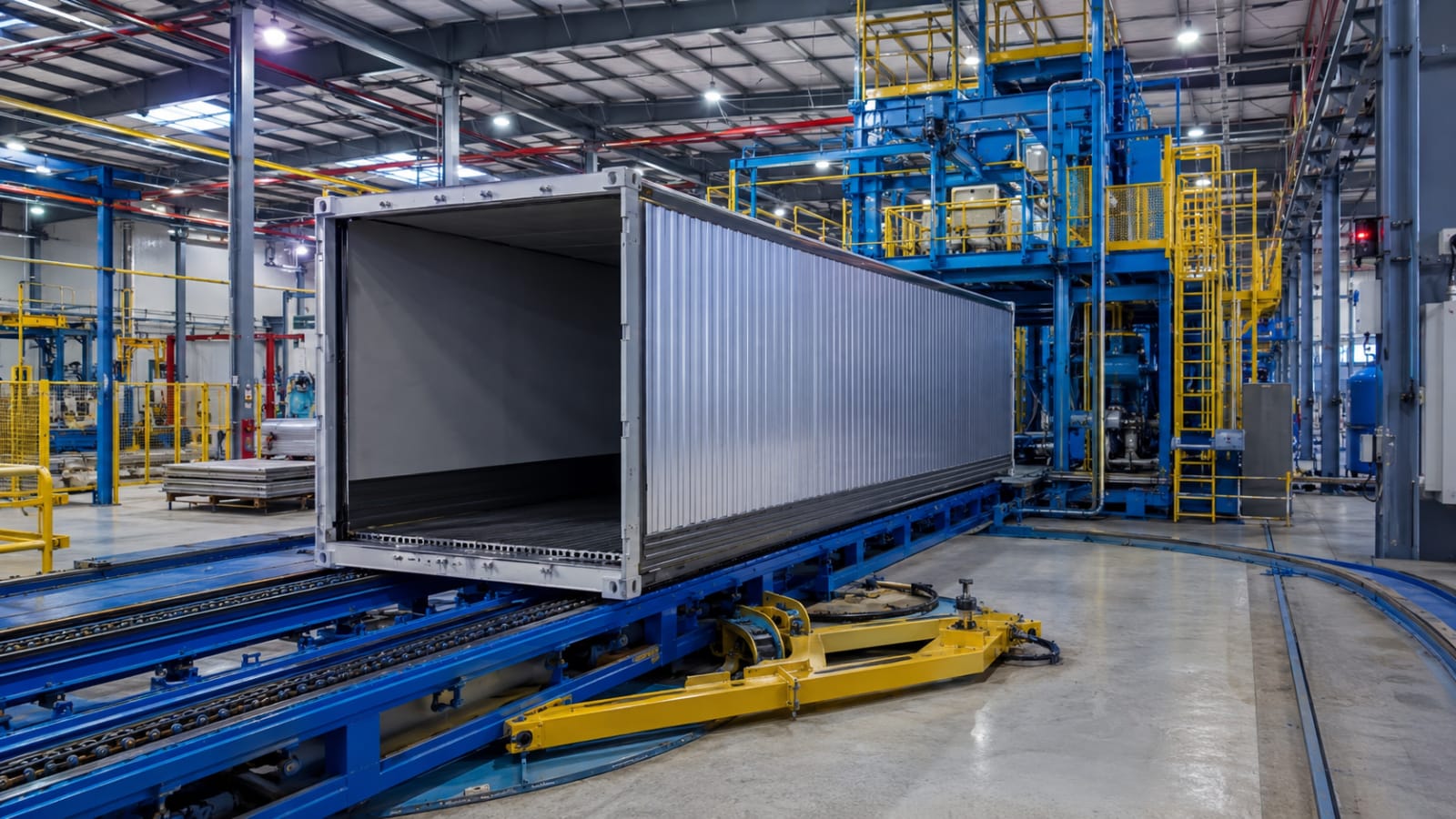


Steel receiving & forming
Corten steel coil is cut to size and formed on a corrugation press, after incoming quality control on grade, gauge and chemistry.
Manufacturing & QA
Shipping container manufacturing at SCS Global runs end to end inside our own factory. We cut and form the steel, weld the frames, cast the structural fittings, coat and inspect every unit, and stamp the CSC plate on the line. SCS is a factory-direct manufacturer of specialised containers, building since 2001 and exporting to more than 60 countries.
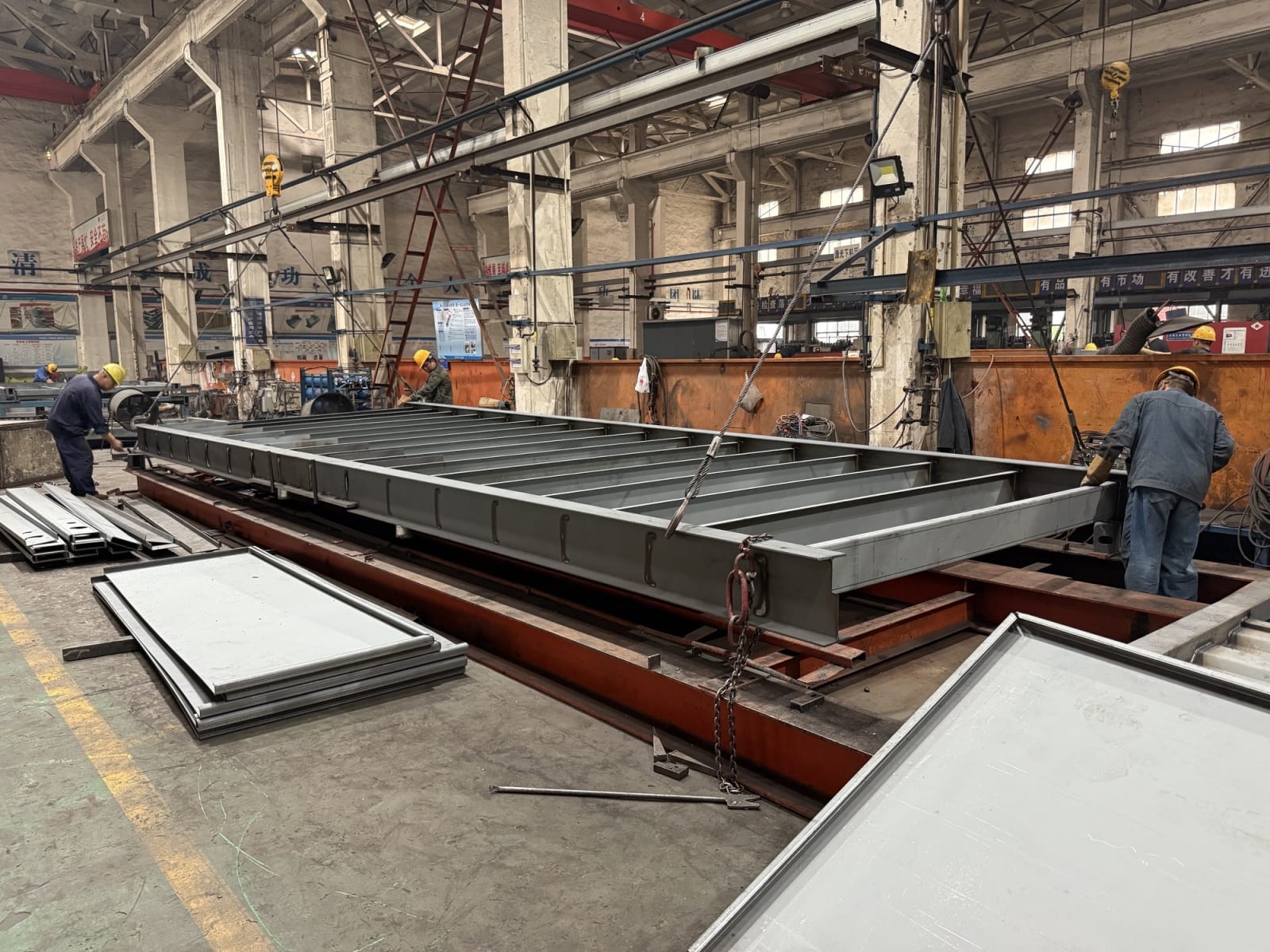
Factory-Direct
SCS Global owns and operates its own factory and casts its own structural fittings on site. That ownership is what separates a manufacturer from a broker: one accountable team takes a unit from raw steel to finished box, with no reseller margin in between.
The clearest proof is the foundry. We cast our own ISO 1161 and offshore-grade DNV corner castings, the structural parts most makers buy in, and SCS-cast components are used by other manufacturers including CIMC. We have built at Yixing, Jiangsu since 2001, employ 320 staff, and export to more than 60 countries.
Capability Pillars
Three pillars underpin every container we build: the materials we control, the standards we produce to, and the inspection rigour that proves it. Each links to the full detail below.
Mill-certified weathering steel (SPA-H), 28 mm marine-grade plywood, ISO 1161 corner castings and a multi-coat marine paint system, every material spec traceable on the QC report.
Factory-owned production under ISO 9001, 14001 and 45001. A ~50,000 m² Yixing facility, four dedicated assembly lines, 300–500 container-equivalent units a month.
An 11-stage QA/QC protocol, weld inspection to ISO 5817, AQL pre-shipment sampling and CSC plating on the line by an authorised classification society before dispatch.
The five pillars
The build, the materials, the quality protocol, the factory and the certification step, each on its own page.
The 14-stage build sequence, from Corten coil to the CSC plate.
Read moreThe 11-stage quality-control protocol, from raw steel to sign-off.
Read moreThe steel grade, gauge, marine ply floor and paint system in full.
Read moreInside the SCS production line: capacity, equipment and in-house casting.
Read moreHow the CSC Safety Approval Plate is issued on the line.
Read moreThe process
SCS builds new containers from weathering steel through a controlled stage sequence, from steel receiving and forming to frame welding, corner-casting assembly, shot-blasting, marine coating, flooring, doors, the water-tightness test and the CSC plate. Every box is built new, never converted from a used unit.
Corten steel coil is cut to size and formed on a corrugation press, after incoming quality control on grade, gauge and chemistry.
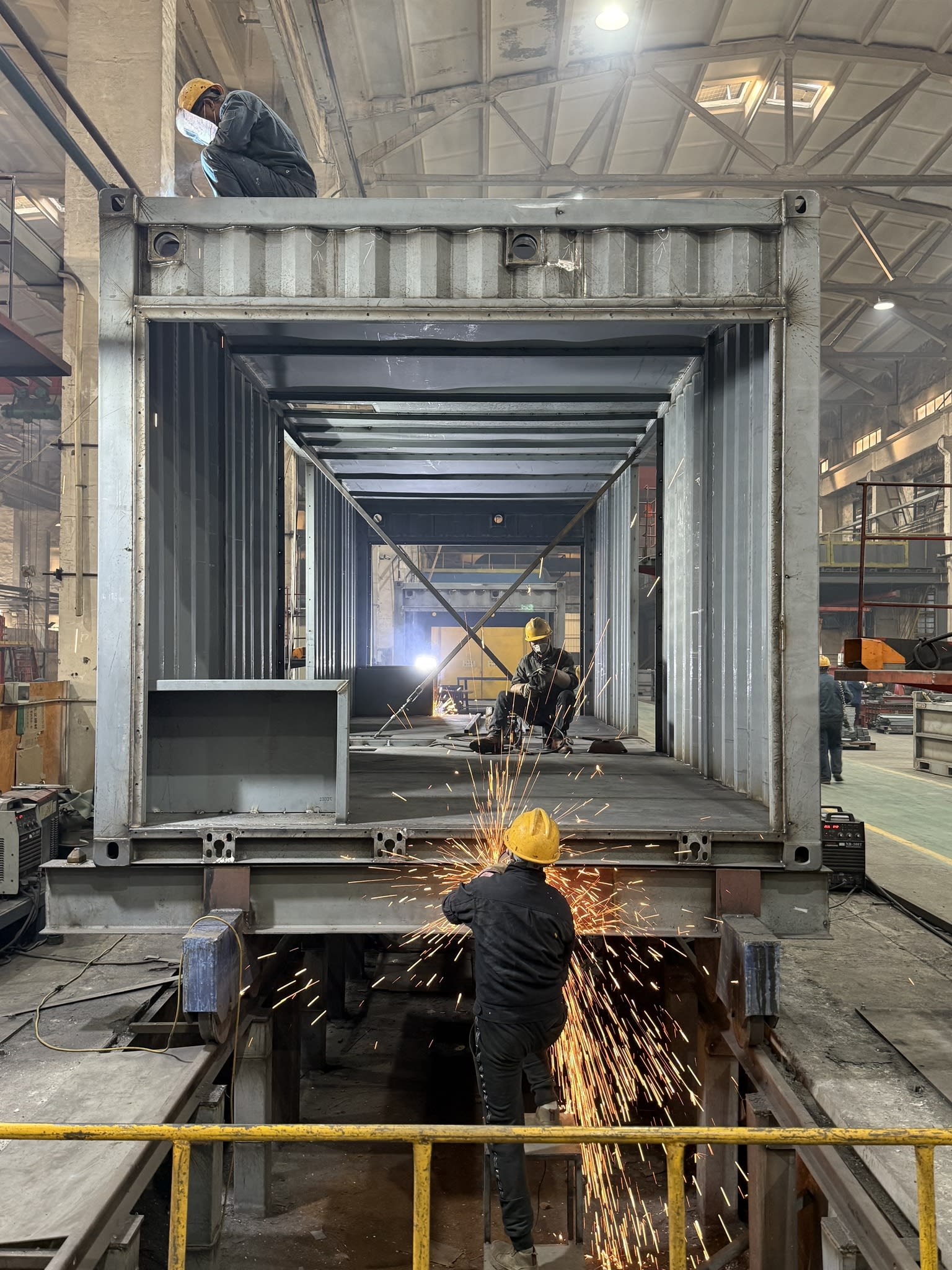
The frame is welded with in-house cast ISO 1161 corner fittings tied in, the certified lifting and stacking points of the box.
Robotic and MIG/TIG welding cells carry the structural welds, each visually inspected before assembly continues.
The whole box is shot-blasted to a clean, profiled substrate (Sa 2.5) before any coating goes on.
A multi-coat marine paint system over the blasted steel, with dry-film thickness verified by calibrated gauges.
A 28 mm marine-grade plywood floor and multi-point door hardware are fitted, then the box is sealed.
A high-pressure water-tightness test, then the CSC Safety Approval Plate stamped on the line after first examination.
Quality control
Container manufacturing quality assurance at SCS runs at every stage, from incoming steel inspection and weld checks to AQL pre-shipment inspection, third-party classification sign-off and Factory Acceptance Testing with full photographic QC reports. Quality is controlled on the line, not assessed after the fact.
Incoming steel inspected for grade, gauge and traceability before fabrication begins.
Every structural weld inspected before assembly continues, accepted to ISO 5817 quality levels.
Dry-film coating thickness checked with calibrated gauges over a Sa 2.5 blasted substrate.
A high-pressure water-tightness test on the sealed box before it is released.
Pre-shipment inspection sampled to an AQL standard (ISO 2859-1), plus Factory Acceptance Testing on engineered units.
“Quality is controlled on the line, not assessed after the fact.”

Materials
SCS containers are built from corrugated weathering (Corten) steel on a welded steel frame, with a 28 mm marine-grade plywood floor, ISO 1161 corner castings and a multi-coat marine paint system over a shot-blasted substrate. The materials are chosen for marine service, not appearance.
The shell uses the SPA-H grade family (JIS G3125, equivalent to COR-TEN A and ASTM A242 and A588), which carries two to eight times the corrosion resistance of ordinary carbon steel. Walls run 1.6 to 2.0 mm corrugated gauge, the floor is tropical-hardwood marine ply screwed to steel cross-members, and the coating is verified for dry-film thickness against the ISO 12944 corrosivity categories after a clean-substrate blast.
Certification
Every SCS container bound for international transport carries a CSC Safety Approval Plate, stamped on the line once an authorised classification society has completed the first examination at the factory. Because we build new units, certification happens at manufacture rather than being retro-fitted. The design is type-tested to the International Convention for Safe Containers (adopted by the IMO in 1972, in force since 1977), an authorised society reviews and inspects, the plate is stamped, and the maintenance regime begins. SCS works with ABS, DNV, Lloyd's Register and Bureau Veritas, the four societies that audit the facility. The plate's stacking and racking values rely on the corner castings we make ourselves, which ties the certified loads to a part we cast and trace on site.
 ISO 9001
  Bureau Veritas
  DNV
DNV  Lloyd's Register
  BIC
BIC  ABS
ABS Facility
SCS Global manufacturing is sized for engineering-led mid-sized and custom runs, not commodity throughput. The Yixing factory runs four dedicated assembly lines across roughly 50,000 square metres, producing 300 to 500 container-equivalent units a month and more than 50,000 units since 2001, all built to the ISO 668 envelope. Splitting the work across four lines is what lets a 30-unit engineered order progress without sitting behind a commodity run, the capacity a buyer on a 20 to 50 unit order actually needs. Coordinated despatch ties into global shipping from the factory and our in-house engineering and design services.

Standards & references
SCS builds to ISO 668, ISO 1496-1, ISO 1161 and ISO 6346, holds ISO 9001, 14001 and 45001 management systems, and is independently audited by ABS, DNV, Lloyd's Register and Bureau Veritas. Follow any link to the source authority for the current revision.
Products supported
Our manufacturing and quality assurance underpins every product line. Follow any link to see how the factory workflow shapes that product category.
Dongas, ablution blocks, kitchens and modular camps, all built through this QA chain.
Explore the clusterDNV 2.7-1 offshore containers, built under classification-society approval using the heavier castings from our own foundry.
Explore the clusterBunded DG storage containers, built, plated and audited at the Yixing factory.
Explore the clusterDownloadable proof
Downloadable documents that back the credentials on this page. Supplementary evidence: the primary content (process, QA, standards and the CSC narrative) lives on this HTML page above.
The factory, the five pillars and the standards we build to, at a glance. Available on request.
Trusted by






FAQ
Five questions procurement teams ask most about SCS Global's shipping container manufacturing and quality assurance. For the full picture, follow the links through to the spokes above.
Yes. SCS owns and operates its factory at Yixing, Jiangsu, China, and builds new units from steel rather than booking capacity in another company's plant. The factory cuts, forms, welds, coats and inspects every unit on one site, and casts its own ISO 1161 corner castings in an in-house foundry, which is the work most container makers buy in.
SCS containers are built at the company's own factory at 9 Yidu Road, Guanlin Town, Yixing City, Jiangsu Province, China, with a Hong Kong commercial head office. The factory has run since 2001, employs 320 staff and exports to more than 60 countries. The full factory tour is set out on the factory capability page.
SCS builds to ISO 668, ISO 1496-1, ISO 1161 and ISO 6346 for container dimensions, structure, corner fittings and marking, plus CSC (1972) for safety approval. The factory holds ISO 9001, 14001 and 45001 management systems and is independently audited by ABS, DNV, Lloyd's Register and Bureau Veritas.
Yes. Every container bound for international transport carries a CSC Safety Approval Plate, stamped on the line after an authorised classification society completes the first examination at the factory. Because SCS builds new units, the plate is issued at manufacture against our own build and test records rather than retro-fitted to a used box.
A factory-direct manufacturer owns the line and is accountable for the build, the materials and the certification. A reseller buys finished boxes and sells them on, inheriting whatever quality arrives. SCS casts its own structural fittings, runs its own QA/QC and stamps the CSC plate against its own records, so the proof traces back to a factory we control.