The nine classes of dangerous goods group hazardous materials by their primary hazard: explosives, gases, flammable liquids, flammable solids, oxidising substances, toxic and infectious substances, radioactive material, corrosives, and miscellaneous dangerous goods. This is the structure behind dangerous goods classification, and it comes from the United Nations Recommendations on the Transport of Dangerous Goods. Australia adopts that system through the ADG Code for transport and the GHS within the Work Health and Safety Regulations for the workplace. Storage then sits under a class-specific Australian Standard plus the state DG or WHS regulator. Each class can carry divisions and packing groups that refine the hazard, where packing group I is the highest danger and group III the lowest. Knowing the class and packing group of a substance is the first decision in specifying compliant storage, because it sets which standard applies and what containment the goods need.
Class 1 explosives and Class 7 radioactive material sit under their own regulatory regimes and fall outside relocatable container storage. The classes most often held in an outdoor DG store are 3, 5, 6, and 8, plus mixed inventories that combine them.
Class 5: Oxidising Substances and Organic Peroxides
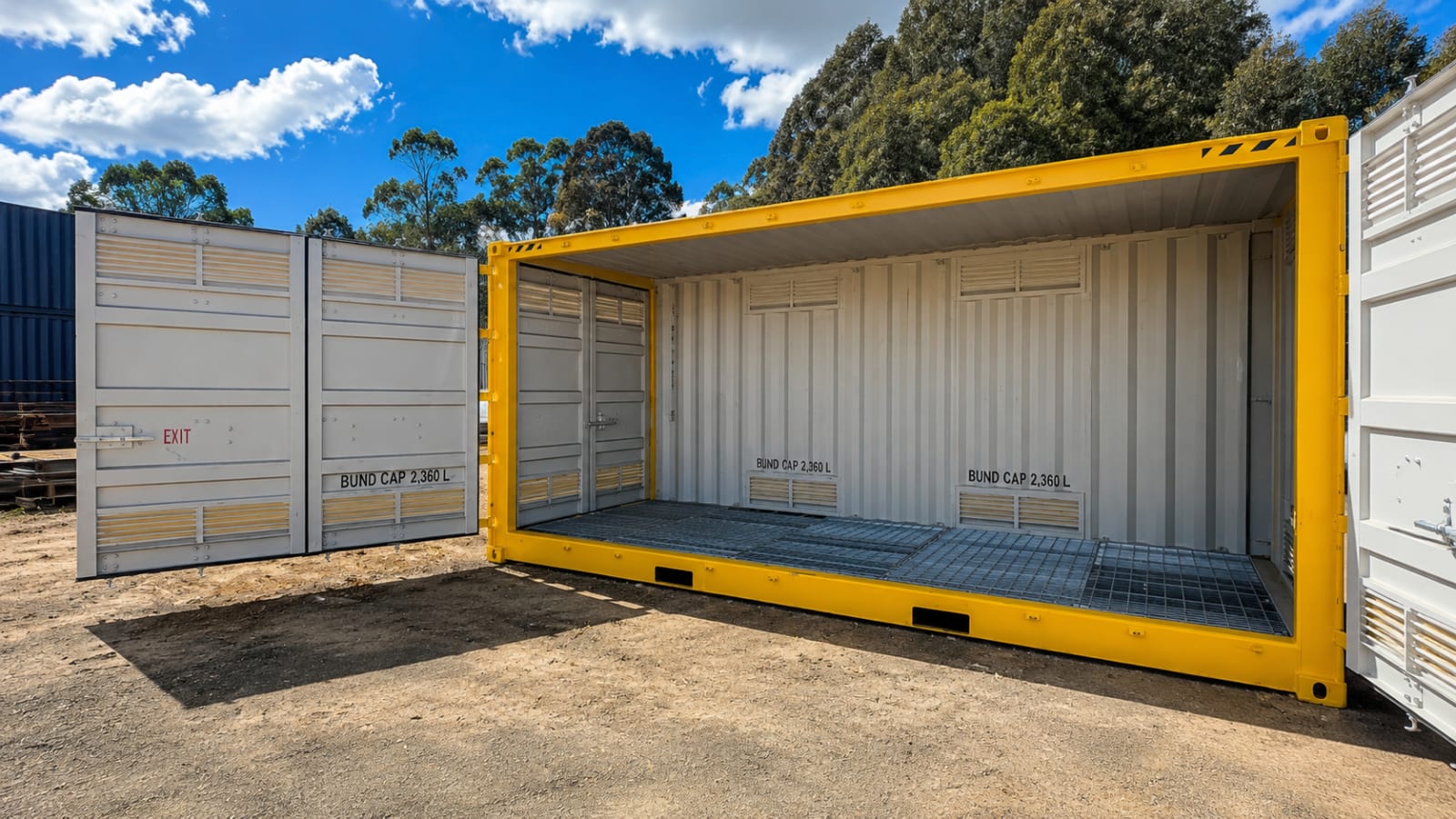
Class 5 dangerous goods are oxidising agents and organic peroxides, substances that release oxygen and intensify a fire even without an external ignition source. Division 5.1 covers oxidising agents such as pool chlorine, ammonium nitrate, and hydrogen peroxide solutions, and class 5.1 dangerous goods are stored under AS 4326. Division 5.2 covers organic peroxides, which need temperature control and are governed by AS 2714. Both divisions have to be kept clear of flammable and combustible material, because an oxidiser feeds a fire that a Class 3 liquid starts. A bunded container with the right segregation and ventilation isolates oxidisers from incompatible classes and contains any liquid oxidiser that leaks.
Class 6: Toxic and Infectious Substances
Class 6 dangerous goods are toxic and infectious substances. Division 6.1 covers toxic substances, materials that cause death or injury if swallowed, inhaled, or absorbed through skin, and class 6.1 dangerous goods are stored to AS/NZS 4452 and the WHS hazardous-chemicals provisions, with containment that stops a spill reaching people, drains, or soil. Division 6.2 covers infectious substances, which fall under biosafety controls rather than general DG storage. For 6.1 toxics held outdoors, a sealed bunded floor and a lockable, ventilated container keeps the goods isolated and the spill captured. Toxic substances are often stored alongside corrosives or flammables, so segregation under AS 3833:2024 matters when classes are mixed.
| Class | Name | Divisions | Controlling AU storage standard |
|---|---|---|---|
| 1 | Explosives | 1.1–1.6 | AS 2187 series |
| 2 | Gases | 2.1 flammable, 2.2 non-flammable non-toxic, 2.3 toxic | AS 4332 (cylinders), AS/NZS 1596 (LP Gas) |
| 3 | Flammable liquids | packing groups I–III | AS 1940:2017 |
| 4 | Flammable solids | 4.1 flammable solids, 4.2 spontaneously combustible, 4.3 dangerous when wet | risk-assessed (AS 1940 where applicable) |
| 5 | Oxidising substances and organic peroxides | 5.1 oxidising agents, 5.2 organic peroxides | AS 4326 (5.1), AS 2714 (5.2) |
| 6 | Toxic and infectious substances | 6.1 toxic, 6.2 infectious | AS/NZS 4452 (6.1) |
| 7 | Radioactive material | None | ARPANSA codes (outside container-storage scope) |
| 8 | Corrosive substances | packing groups I–III | AS 3780:2023 |
| 9 | Miscellaneous dangerous goods | environmentally hazardous substances, lithium batteries | risk-assessed, AS 3833:2024 where mixed |