
Refrigerated & Cold Storage
Reefer Containers: Refrigerated Shipping Containers
A reefer container is an insulated shipping container with its own built-in refrigeration unit, holding a set point between −30°C and +30°C for cold storage on site or chilled and frozen cargo in transit. SCS Global builds every reefer container it sells new at its own factory in Yixing, Jiangsu, and ships to 17 countries. The range covers 10ft, 20ft and 40ft high cube integral reefers, with single-phase, pallet-wide, blast-freezer and cold-room builds to order for mining, energy, food-export and defence projects.
The Range
The Range by Size: 10ft, 20ft and 40ft High Cube
The range runs 10ft, 20ft and 40ft high cube integral reefers on ISO 668 envelopes, 12.2 m³ to 68.5 m³ internal. ISO 668:2020 rates 20ft and 40ft high cube bodies at 36,000 kg gross, but Australian new-build listings plate at 22,111 kg to 24,000 kg. Weights are category references, plated at quote. Every row shares foam-cored panels, stainless lining, an aluminium T-section floor and a front-end OEM unit. Specifications conform to industry standards. Confirm to project requirements.
| Product | External L × W × H (mm) | Cubic (m³) | Pallets (CHEP) | Tare / max gross (kg) | Unit and power |
|---|---|---|---|---|---|
| 10ft reefer | 2,991 × 2,438 × 2,591 | 12.2 | 4 | 2,060 / at quote | Integral unit, −30°C to +30°C |
| 20ft reefer | 6,058 × 2,438 × 2,591 | 28.3–28.9 | 10 | 2,770 / 36,000 ISO rating | 3-phase 32 A 5-pin, single-phase option |
| 40ft high cube reefer | 12,192 × 2,438 × 2,896 | 67.3–68.5 | 22 | 4,360–4,650 / 36,000 ISO rating | Same unit class as 20ft |
| 20ft pallet-wide reefer | 6,058 × 2,500 × 2,896 | 33.5 | 2 AU pallets abreast (16 with bars) | 3,740 / 35,000 | Storage fit-out |
| 40ft pallet-wide reefer | 12,192 × 2,500 × 2,896 | 71.3 | 2 AU pallets abreast | 4,580 / 35,000 | Storage fit-out, fork pockets |
| Blast freezer, 20ft / 40ft | 6,060 × 2,440 × 2,600 / 12,190 × 2,440 × 2,900 | 22.3 / 52.8 | 7 / 14 | 3,000 / 7,040 tare | −40°C, 76,000 kcal/h |
Complete Range
The Complete Reefer Range
Each size has its own specification page, plus two buying guides.

20ft Reefer Container
The core size, built new: 28.3 m³ and 10 CHEP pallets, standard-height or high cube.
20ft reefer container
40ft Reefer Container
The standard 40ft reefer form is the high cube: 67 m³ and 22 CHEP pallets.
40ft reefer container
Reefer Container Specifications
Dimensions, weights, temperature, power and consumption, tabled by size.
reefer container specifications
Reefer Container vs Cold Room
A containerised reefer against a built cold room: cost, capacity and relocation compared.
reefer container vs cold room comparison
Built to Order
Refrigerated Containers Built to the Project Brief
SCS Global manufactures refrigerated containers at its own factory: ISO 1496-2 thermal container bodies with a type-approved refrigeration unit, built new to the project brief. A container reefer in that form holds −30°C to +30°C. Built to order: 240 V single-phase units, 2,500 mm pallet-wide bodies, blast freezer and super-freezer builds to −75°C, controlled atmosphere and cold-room fit-outs. SCS sells new units and doesn't offer refrigerated container rental or reefer hire.
Specifications
Specifications: Dimensions, Temperature Range and Power
A standard integral reefer holds a set point between −30°C and +30°C on a three-phase 380–460 V, 32 A, 50/60 Hz, 5-pin supply, in ambients from −30°C to +50°C. A reference OEM unit draws 13.5 kW at maximum and delivers 10 kW of cooling at +2°C against +38°C ambient. Reefer container refrigeration systems use 3 kWh to 7 kWh per hour, or 70 kWh to 170 kWh a day.
Cold Storage
Cold Storage and Blast Freezer Options
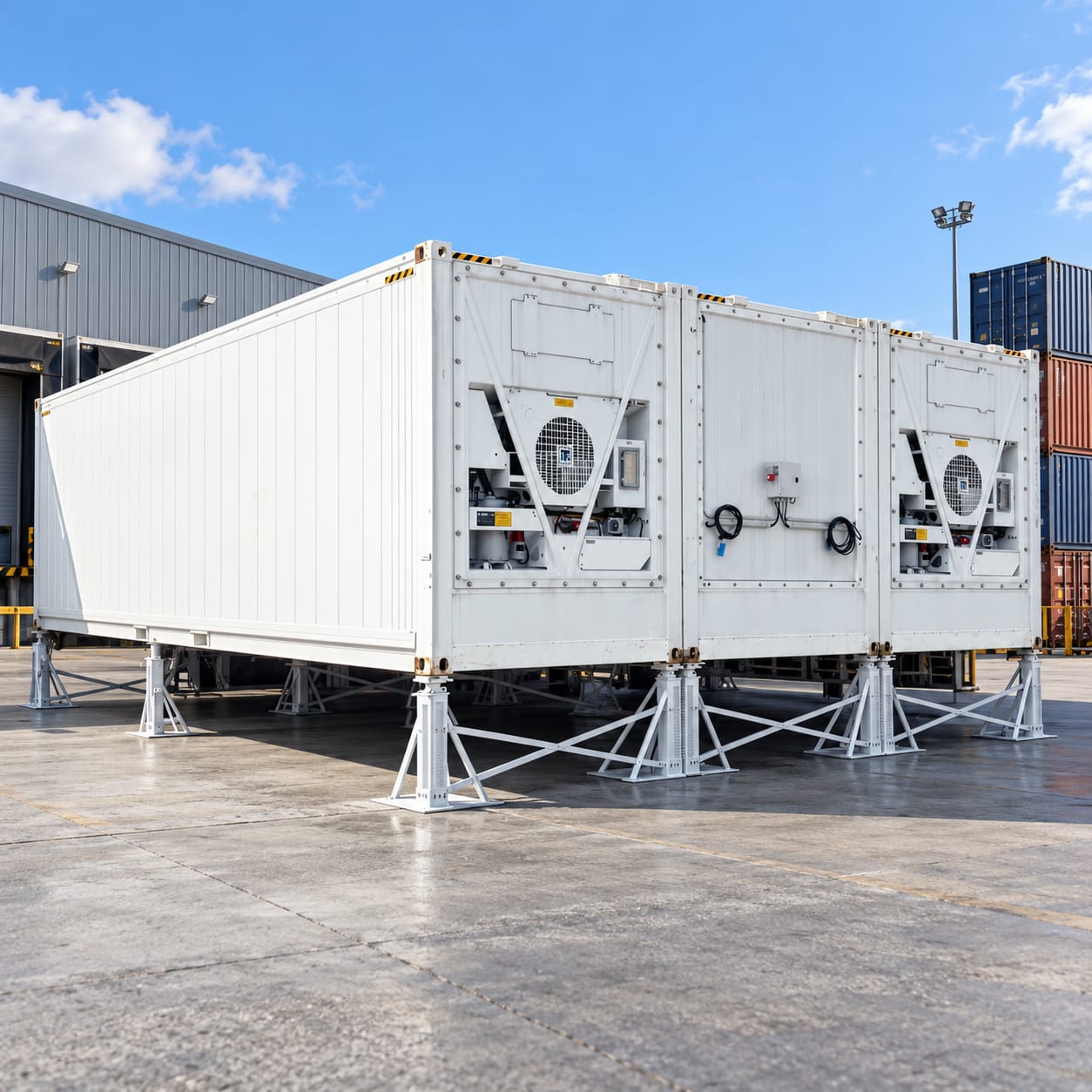
A reefer works as site-based cold storage as readily as export cargo. As a cold storage container it holds 5°C or colder under FSANZ Standard 3.2.2, or −18°C as a freezer shipping container. A cold room container fit-out adds a personnel door and shelving, and a blast freezer container pulls product down through a narrow air tunnel. Units join, stack two-storey or tunnel-connect as modular cold storage, and a refrigerated storage container relocates between projects.
In the Field
Reefer Deployments in the Field
Reefers land where a food store has to arrive working: camp kitchen pads, energy laydowns, packing yards and defence bases. See our delivered projects.

Mine Camp Catering Cold Store
Sized to the camp population, the cold store runs on site three-phase power or a genset.
View project
Port-Side Food Export Loading
Exporters stage chilled and frozen loads in plated reefers at the packing yard.
View projectFactory-Direct
Our Manufacturing Advantage

SCS Global builds its reefers factory-direct in Yixing, Jiangsu: foam-cored sandwich bodies on Corten ISO frames, built to ISO 1496-2, with the refrigeration unit fitted at the factory. Resellers and hire fleets move used units, but SCS is a reefer container manufacturer, with foaming, fabrication and pre-trip inspection on one line: our manufacturing process. Corten steel and insulation construction covers the shell and panel build.
Machinery and refrigerant
Units running R134a, R513A or R1234yf follow ISO 20854:2019, the flammable-refrigerant safety standard.
From the Director of Engineering
"We build integral reefers new because a refurbished unit's insulation has already spent years cycling, and factory-direct means the engineers who drew your unit inspect it before it ships." Adam Baker, Director of Engineering, SCS Global.
Global Delivery
Global Delivery
Indicative transit times
Sea freight, port-to-port from China, in weeks. Add 1 to 2 weeks for handling and customs. Industry-typical, not SCS guarantees.
| Destination | Factory → Site |
|---|---|
| Oceania (AU / NZ) | ~3–4.5 weeks |
| South-East Asia | ~1–2 weeks |
| Middle East | ~3–4 weeks |
| Africa | ~4.5–6 weeks |
A finished reefer keeps the ISO 668 envelope and carries a CSC plate, so it ships as standard container freight by sea, rail and road to 17 countries. Under the International Convention for Safe Containers, a plated refrigerated shipping container books like any other box, and a reefer shipping container runs on ship's power in transit.
Factory to site
A side-loader or crane sets it on a pad. Freight routes sit under global shipping and cold chain logistics, dry boxes under the standard container range. Export markets reference the ATP agreement insulation benchmark, which Australia hasn't joined.
Applications
Applications and Industries
Food Export
FSANZ Standard 3.2.2 holds the Australian operator of a food grade refrigerated shipping container to 5°C or colder for potentially hazardous food. Cold chain compliance for containerised cold storage and cold chain regulations for shipping containers sit with the food business, not the box.
Mining and Remote Camps
Reefers hold the camp food store beside the kitchen block: cold chain catering on mine sites.
Oil, Gas and Energy
Remote sites take reefer containers for energy projects, run from site power or a genset.
Defence and Medical
A temperature controlled shipping container supports defence cold chain deployments and pharmaceutical storage in modular medical facilities.
One cold chain container platform, four applications.
Compliance
Compliance and Certification
Compliance attaches to four layers. The body carries ISO 1496-2, ISO 668, ISO 1161 and a CSC plate. The machinery carries the OEM's type approval and ISO 20854. In Australia the site carries an AS/NZS 3000 reefer outlet, AS/NZS 5149 for stationary plant and ARCtick licensed commissioning. The food business holds FSANZ Standard 3.2.2 and HACCP. A reefer is never HACCP certified in itself.
 ISO
ISO  Bureau Veritas
  DNV
DNV  Lloyd's Register
  BIC
BIC  ABS
ABS FAQ
Frequently Asked Questions
The questions buyers ask most often about reefer containers.
What is a refrigerated container used for?
A reefer is an ISO 1496-2 thermal container with an integral electric refrigeration unit in the front bulkhead. It holds a set point between −30°C and +30°C for export cargo in transit or static cold storage on site. The specifications guide tables every size.
How does a refrigerated shipping container hold temperature?
The unit runs a compressor, condenser and evaporator cycle. It pushes supply air under the cargo through the aluminium T-floor channels and returns it over the load, so air passes through the product. A controller logs supply and return air, defrost and set-point events.
What power supply does a reefer need on site?
A three-phase 380–460 V, 32 A, 50/60 Hz, 5-pin reefer socket, installed to AS/NZS 3000 on site. Sites without three-phase supply specify a 240 V single-phase unit. Off-grid or in transit, a 15 kVA to 25 kVA clip-on or underslung genset carries each reefer.
How much does a refrigerated container cost?
A refrigerated container price is set by size, set-point tier, single-phase or three-phase unit, OEM unit, cold-room fit-out, pallet-wide body, quantity and sea freight. SCS quotes factory-direct against those drivers, not from a reefer container price list. Request a quote and we'll return the reefer container cost.
How long can a reefer container be unplugged?
A loaded reefer holds temperature for about four to six hours unplugged, by industry consensus. Frozen cargo at −18°C holds four to eight hours, chilled cargo two to four hours before it passes 5°C, and super-freezer loads eight to twelve. Plan disconnections under two hours and run a genset beyond that.
Do you hire or rent refrigerated containers?
No. SCS builds and sells refrigerated containers new, factory-direct from Yixing, and doesn't hire, rent or resell used units. You own the unit, and a plated reefer moves to the next project as standard container freight instead of going back to a hire yard.