
Three-Phase High Cube Integral Reefer
The standard build: 12,192 × 2,438 × 2,896 mm on a 32 A three-phase supply.

12,192 × 2,438 × 2,896 mm ISO 1AAA body, about 11,580 × 2,290 × 2,400 mm inside, 67.3 m³, approx. 22 pallets. Stainless lining, aluminium T-section floor, polyurethane foam panels, Corten ISO frame. 3-phase 380–460 V 32 A supply, 240 V single-phase to order.
Body to ISO 1496-2:2018 on the ISO 668 1AAA envelope with ISO 1161 corner fittings, CSC plated for international transport. Machinery under OEM type approval and ISO 20854:2019. Site outlet to AS/NZS 3000, AS/NZS 5149.3 for stationary cold storage, ARCtick-licensed commissioning in Australia.
Food processors, exporters staging at port, mine-camp central cold stores and distribution overflow. Arrives by side-loader or crane truck onto a level hardstand and runs from one 32 A outlet or a genset.
Overview
SCS Global builds the 40ft high cube reefer factory-direct in Yixing, Jiangsu, as part of our reefer range from 10ft to 40ft with about 67 m³ of refrigerated storage on one 32 A outlet, plated as an ISO thermal container and shipped worldwide. Buy a 40ft reefer anywhere and you get the high cube by default. SCS builds the standard-height and pallet-wide bodies to order on the same unit class, the body foamed, lined and framed at our factory and the OEM unit fitted before dispatch.

Specifications
The 40ft reefer container is the high-cube form of the reefer range: a 12,192 × 2,438 × 2,896 mm ISO 1AAA body holding about 67 m³ and 22 pallets at −30°C to +30°C. That is more than double the 28.3 m³ of the standard 20ft reefer, on about 26.3 m² of floor against 12.3 m². SCS builds every 40ft high cube reefer container to order, the whole plated under ISO 668 at the 1AAA rating of 36,000 kg. Both sizes carry the same integral unit class, 10.0 kW at +2°C and 5.9 kW at −18°C on a reference unit, so the 40ft runs on roughly 40% of a 20ft's cooling capacity per cubic metre. The 40ft reefer container dimensions below lead with the high cube body. Specifications conform to industry standards. Confirm to project requirements.
| Specification | Value |
|---|---|
| Container type | 40ft high cube integral reefer, ISO 668 1AAA |
| Build standards | ISO 1496-2:2018 thermal container, ISO 668 1AAA envelope, ISO 1161 corner fittings, CSC plated for international transport |
| External dimensions (L × W × H) | 12,192 × 2,438 × 2,896 mm (40' × 8' × 9'6") |
| Internal dimensions (reference build) | 11,580 × 2,290 × 2,400 mm. Range by build 11,500 to 11,580 × 2,270 to 2,290 × 2,400 mm |
| Door opening (W × H) | 2,290 × 2,570 mm |
| Internal cubic capacity | 67.3 m³ |
| Floor area | approx. 26.3 m² |
| Pallet capacity | approx. 22 standard pallets, floor-loaded |
| Tare weight (category reference) | 4,360 to 4,650 kg. SCS plated values on request |
| Payload (category reference) | approx. 29,520 kg against a 34,000 kg plated gross. SCS plated values on request |
| Maximum gross weight | ISO 668 rating 36,000 kg (30,480 kg pre-amendment, still printed in most fleet tables). SCS plated value on request |
| Set-point range | −30°C to +30°C (standard integral unit) |
| Power supply | 3-phase 380 to 460 V, 32 A, 50/60 Hz, 5-pin plug. 240 V single-phase unit to order |
| Reference unit cooling capacity | 10.0 kW at +2°C and 5.9 kW at −18°C (38°C ambient), 13.5 kW maximum draw |
| Running consumption (category range) | approx. 140 to 170 kWh per day at −18°C, lower at chilled set points |
| Fresh-air exchange | Adjustable 0 to 250 m³/h |
| Humidity control | 60 to 85% RH on units so equipped |
| Floor | Aluminium T-section floor |
| Interior lining | Stainless steel |
| Insulation | Polyurethane foam sandwich panels |
| Frame | Corten steel ISO frame with ISO 1161 corner castings |
| Doors | Insulated double rear doors. Internal emergency release and alarm on storage builds |
| Lighting and air loss | 220 V internal LED, strip curtains at the door |
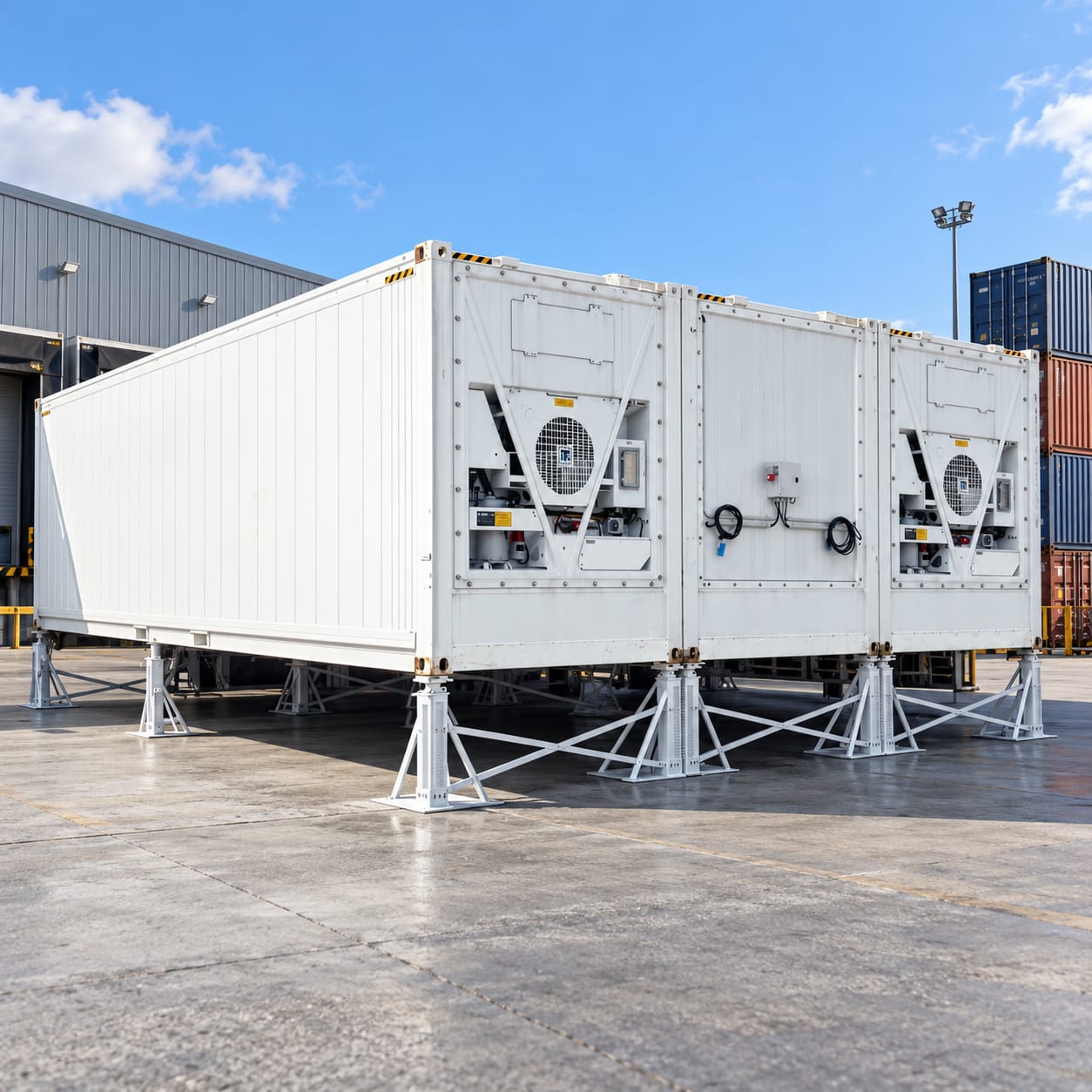
Cold Storage
A 40ft high cube reefer suits bulk chilled and frozen storage where a 20ft runs out: food processors, exporters staging at port, mine-camp central cold stores and distribution overflow. Meat and seafood plants run it as seasonal surge capacity, packers stage export loads beside the shed, and ports hold peak overflow. On a remote site one unit becomes the central cold store for the camp kitchens, the anchor of cold storage for mining camps. The set point and the logging come from the operator's duty, not the container. FSANZ Standard 3.2.2 sets the 5°C ceiling for potentially hazardous food, and the controller's supply-air and return-air log is the operator's evidence.

Construction
Every 40ft refrigerated container runs a foam-cored, stainless-lined body on an aluminium T-section floor and a Corten ISO frame, with an OEM refrigeration unit mounted in the front-end frame. The floor channels supply air under and through the load. The unit is a type-approved integral machine in the Daikin, Carrier, Thermo King or Star Cool class, holding −30°C to +30°C and logging supply and return air. A high cube refrigerated container carries the same unit class as a 20ft, 10.0 kW at +2°C and 5.9 kW at −18°C on a reference unit. Over 67 m³ the body's heat leakage carries more of the load. The heat-leakage and cooling-capacity tests in ISO 1496-2 are the 40ft's critical QA gate, and thermal bridging matters more on the long body.

Delivery
A 40ft high cube arrives by side-loader or crane truck, sits on a level hardstand, and runs from one 32 A 3-phase outlet or a genset. It's too long for a tilt tray: a side-loader sets it down beside the truck, and a crane truck handles tight pads and piers. At 2,438 mm wide it travels inside the NHVR 2.5 m general-access width, and the 2,896 mm body tops the 4.3 m general-access height on a standard skel, so the carrier books a drop-deck. On site it needs one 32 A 5-pin three-phase outlet to AS/NZS 3000, or 240 V for a single-phase build, and an ARCtick-licensed technician commissions it in Australia. A clip-on genset covers transit and off-grid running, and a pre-trip inspection (PTI) plus the ISO 1496-2 body tests are the category's pre-dispatch checks.
Compliance
SCS certifies the container body it builds. The refrigeration OEM, the site electrician and the food business each certify their own layer. Body: SCS builds the 40ft to ISO 1496-2:2018 on the ISO 668 1AAA envelope with ISO 1161 corner fittings, plated under the International Convention for Safe Containers. Machinery: type approval sits with the OEM unit, and flammable-refrigerant units follow ISO 20854:2019. Site: the installer wires the 32 A outlet to AS/NZS 3000, AS/NZS 5149.3 governs stationary cold storage, and in Australia an ARCtick-licensed technician commissions the unit. Operator: the food business runs FSANZ Standard 3.2.2 controls and a HACCP plan around the unit. Neither certifies the container. ATP is an export benchmark, not an Australian requirement: its ATP Guide fixes minimum airflow at 3,000 m³/h above 60 m³, the 40ft high cube's band.
 ISO
ISO  Bureau Veritas
  DNV
DNV  Lloyd's Register
  BIC
BIC  ABS
ABS Standards & References
Every 40ft reefer we manufacture is engineered against the standards below. Click through to the source authority for the full text and current revision.
Configuration Options
Buy a 40ft reefer anywhere and you get a high cube reefer container by default. ISO 668 designates the 2,896 mm high cube as 1AAA and the 2,591 mm standard-height body as 1AA, a legacy build for height-limited yards and vessel slots. SCS builds each 40 high cube reefer container variant below to the project brief, plus the 40ft blast freezer and joined modular cold storage. Compare a reefer with a built cold room before sizing either.
The standard build: 12,192 × 2,438 × 2,896 mm on a 32 A three-phase supply.
For sites without three-phase supply, built to order on the same body.
12,192 × 2,500 × 2,896 mm external, approx. 11,594 × 2,375 × 2,591 mm internal, around 71.3 m³, two Australian pallets abreast.
12,192 × 2,438 × 2,591 mm external, approx. 11,560 × 2,280 × 2,250 mm internal, approx. 59.3 m³, for height-limited yards and vessel slots.
Deep-freeze set points for seafood and pharma cargo.
Personnel door, internal release and siren, shelving and load bars for walk-in site cold storage.
Daikin, Carrier, Thermo King or Star Cool class integral unit fitted at the factory.
Applications
A 40ft high cube reefer suits bulk chilled and frozen storage where a 20ft runs out: food processors, exporters staging at port, mine-camp central cold stores and distribution overflow. One unit on a remote site becomes the central cold store for the camp kitchens.
Cold storage for mining camps: one 40ft unit becomes the central cold store for the camp kitchens, on site supply or a genset.
Central catering cold stores for LNG and remote energy camps, delivered to the laydown as standard container freight.
Bulk project cold storage and distribution overflow that relocates by side-loader or crane truck between works.
Base and forward-location cold chain for rations and medical stock, held at set point on one 32 A outlet or a genset.
Send the set point, variant and destination. An SCS engineer scopes the build factory-direct from Yixing.
Engineering Resources
Spec sheet, dimensioned drawing and compliance summary for engineering review, available on request with your quote. Every engineering document published here has a crawlable HTML equivalent elsewhere on the page.
Mirrors the HTML spec matrix with the standard-height and pallet-wide rows.
DownloadDimensioned side elevation and plan.
DownloadISO 1496-2 / ISO 668 / ISO 1161 / CSC body identity plus site-installation notes (AS/NZS 3000, AS/NZS 5149.3, ARCtick).
DownloadRelated Products
Sister pages in the SCS refrigerated container range, built on the same Yixing line against the same four-layer compliance posture.

The core size: 28.3 m³ and 10 pallets on a 6,058 mm ISO footprint, same integral unit class, one 32 A outlet.
the standard 20ft reefer Dimensions, set-point ranges, power supply and consumption for every size, 10ft to 40ft high cube.
the specifications guide When a plated reefer beats a built cold room, and when it doesn't. Blast freezer and joined modular cold storage options.
compare a reefer with a built cold roomFAQ
Four questions procurement, operations and engineering teams ask most often about the 40ft high cube reefer.
A reference build measures 11,580 × 2,290 × 2,400 mm internally inside a 12,192 × 2,438 × 2,896 mm ISO 1AAA envelope, with a 2,290 × 2,570 mm door opening: about 67 m³ and 26 m² of floor. The front-bulkhead unit shortens internal length about 450 mm against a dry box.
Around 22 standard pallets floor-loaded in the 2,438 mm body. A 2,500 mm pallet-wide body fits two Australian 1,165 mm pallets across, and F-track load bars allow a second tier on cargo that can carry it. SCS builds both the pallet-wide body and the load-bar tracks to order.
Site supply is three-phase 380 to 460 V, 32 A, 5-pin. A reference unit draws up to 13.5 kW, and a 40ft held at −18°C uses roughly 140 to 170 kWh a day, lower when chilled and 25 to 40% higher in hot climates. The specifications guide covers power.
One 40ft gives about 67 m³ against roughly 57 m³ across two 20ft units, on one outlet, one unit to service and less tare per cubic metre. Two 20ft units give independent set points, redundancy and placement flexibility. Step down to the 20ft when the load splits.